A business does not need to sell electricity to the grid to earn on the aFRR and mFRR markets. For the power system, using 500 kW less is worth the same as selling 500 kW. When a battery covers part of the site's own load at the moment the grid needs capacity, the business is paid for that flexibility.
- You can earn on aFRR and mFRR without exporting power: lowering your own load counts the same.
- No electricity sales licence is needed; an optimisation partner handles the market side.
- The same battery also cuts the peaks that set your grid fees.
The question we hear most
A production manager hears that batteries can earn money on the balancing markets. It sounds interesting, until the next thought arrives: “We are a factory, not a power plant. We do not sell electricity, and we do not want a sales licence.”
That is the most common reason businesses stop looking. It is also based on a misunderstanding. This article explains why a business can earn on aFRR and mFRR without exporting a single kilowatt-hour, what the battery does in a normal working day and how to tell whether your site is a good fit.
What are aFRR, mFRR and FCR?
Production and consumption on the grid must match at every moment. When they drift apart, the grid frequency moves away from 50 Hz, and the grid operator buys reserve capacity to bring it back. Think of it as a standby fee: you are paid for being ready to help, and paid again when you actually do.
- FCR (frequency containment reserve) reacts within seconds and keeps the frequency stable.
- aFRR (automatic frequency restoration reserve) starts automatically and restores balance within minutes.
- mFRR (manual frequency restoration reserve) is activated on request and covers longer imbalances.
A battery suits all three well. It reacts in a fraction of a second, follows a signal precisely and does not wear like a generator that has to start and stop.
How a business takes part without exporting
For the grid, the only thing that matters is how much capacity is freed at the moment it is needed. If your site lowers its consumption by 500 kW, 500 kW is freed, exactly as if someone had sold 500 kW to the grid.
A battery lets you do that without touching operations. When the grid needs capacity, the battery covers part of your load and less is drawn from the grid. Machines, cooling and lighting keep running as usual; only the source of the energy changes for a few minutes. Most large consumers on these markets never export anything at all.
The battery covers 500 kW of your own load.
=
Freed capacity, same as 500 kW sold.
=
For flexibility, without exporting or a sales licence.
What the battery does in a day
- Charges in cheap hours, often at night or when your own solar produces.
- Covers the peak load that sets your grid fees.
- In between, stands ready for an FCR, aFRR or mFRR signal.
- Uses stored energy in expensive hours, so less is bought from the grid.
An optimisation partner runs the battery, so you never trade energy yourself.
Three ways the same battery pays
A business battery earns on site first. Market income comes on top, not instead.
- Lower peaks and grid fees. A few short spikes in demand can decide what you pay for grid capacity. The battery covers those spikes, so the grid only sees a flatter line.
- Cheaper hours. Prices move every hour. The battery charges when power is cheap and covers your load when it is expensive. Sites with two grid connections can go further, for example charging through a fixed-price connection while the other follows the exchange price.
- Reserve income. In between, the battery stands ready for FCR, aFRR or mFRR signals and is paid for that readiness.
Will it put production at risk?
No. How much of the battery is kept for backup and peak shaving, and how much is offered to the markets, is agreed when the system is designed. An optimisation partner runs the battery on the markets within those limits, so you never trade energy yourself.
You also see what happens. We help you read the battery’s data and report the savings in a form your finance team can use, which is often the part companies find hardest.
Example: a Finnish shipyard
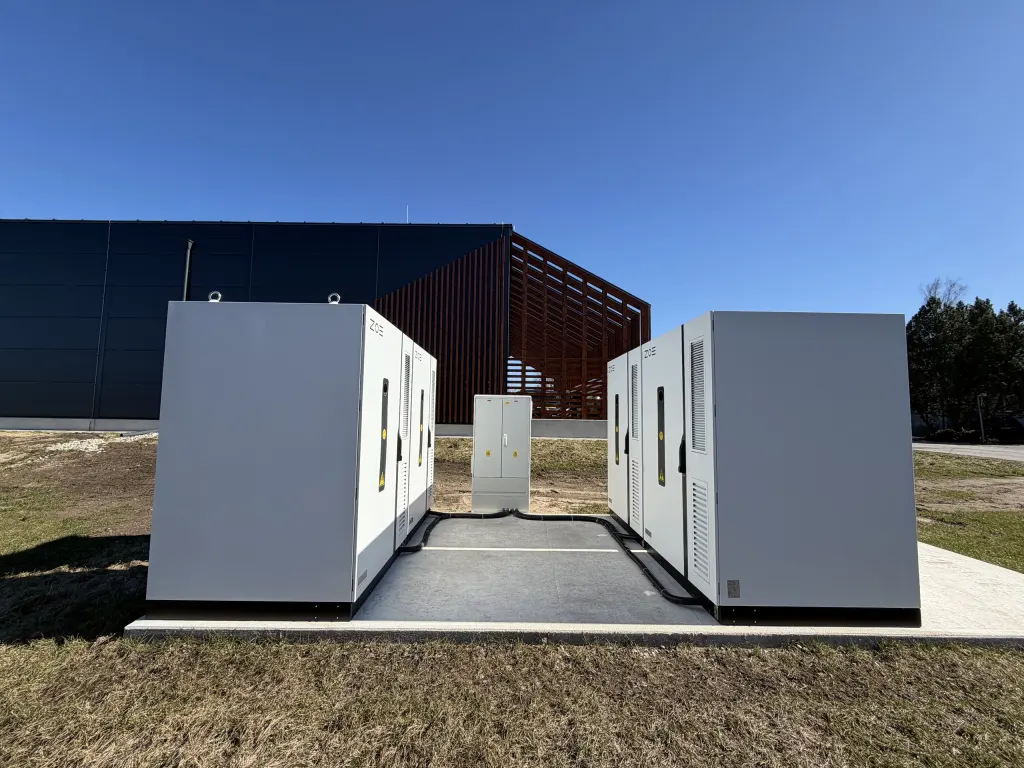
A 400 kW / 500 kWh industrial battery runs at the grid connection point of a shipyard in Finland. Heavy machinery and irregular production schedules used to create high peaks. Today the battery cuts those peaks, provides backup capacity and earns on the FCR, aFRR and intraday markets. It runs continuously with minimal maintenance. Read the full reference →
Is my site a good fit?
The best candidates share a few traits. You do not need all of them.
- A high electricity bill, not only high consumption: what matters is how much you pay.
- Short, sharp peaks from machines, cooling, heating, drying or EV charging.
- Your own solar that is sold cheaply at midday.
- A grid connection near its limit, where adding capacity would be slow or expensive.
- A need for backup for processes that should not stop.
Factories, shopping centres, offices and farms all fit this pattern. See how it works on our Business & industry page.
What we need to start
Consumption data from your grid operator or energy meter, your grid connection details and your goal: a lower bill, backup power or market income. From that we size the battery and give a first estimate of savings, income and payback before any commitment.